
Cadillac Hank and the Dirty Faro Bank
Recently I spent a month traveling the length and breadth of the USA, meeting with people who had cheated or worked with cheats, or who were serious collectors of vintage gambling equipment. I recorded many hours of fresh audio, and took hundreds of photos, aimed at one day producing follow up volumes to Thieving Bastards. Hopefully that won’t take another thirty years.
I wanted to share the following story, which relates to the game of faro.
Faro (pharaoh, pharao or farobank) which originated in France in the 17th century, was the biggest game in America in the 19th century. In fact, it was played in Vegas into the 1930s and probably was still popular in certain locales into the following few decades.
Notoriously, faro was a game that could easily be “run flat”. There are many ways to cheat at the game, both from the inside and from the outside. In fact, when George Devol famously warned Canada Bill Jones that the game he was losing his illicit monte earnings to was “as crooked as the Mississippi”, he was definitely talking about faro.
When faro died out, replaced by poker, baccarat and blackjack, it lived on occasionally in con games. Typically, it was used for a scam known as a “big store”, where a sucker thinks he has been brought into the confidence of professional cheats to exact revenge on a greedy gambling house. The conmen would use faro because it had been largely forgotten and the chosen sucker would quickly screw up the agreed signals and then feel that he was at fault for losing all the cheaters’ money, as well as his own. Of course, everyone except the sucker would be in on the play, including all the “staff” and “patrons” at the gambling joint.
Because faro is long extinct, and the pro hustlers who stole with it were working up until the first half of the twentieth century, I had ZERO chance of ever meeting and interviewing anyone associated with the game. But this story, related to me by a good friend who is both a collector and a “reformed gambler”, gives a small insight into that lost world.
Can you tell me again the story about that faro dealing box that you found?
Well, quite a few years ago, I'm saying around maybe twenty-five years ago, I was in the antique store in Superior, Wisconsin. And I saw a box in one of the little showcases that they had in the shop. I had seen pictures of a faro box and it kind of looked like that, so I asked to see it.
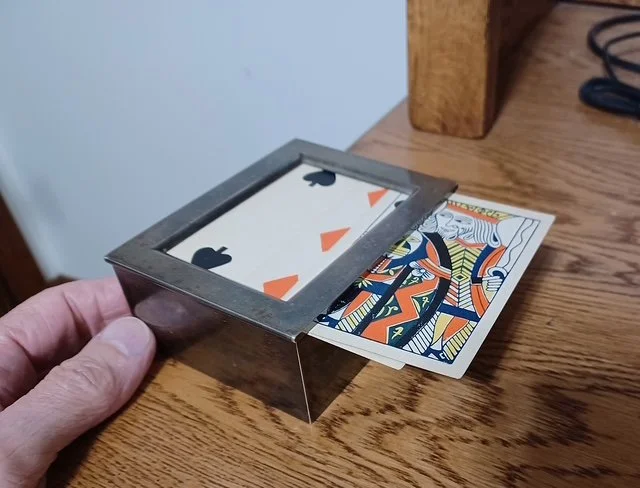
A vintage gaffed faro box, exposing two cards being dealt as a single.
When I pressed down, I could see the top was spring-loaded and that it's a faro box. The guy sold it to me for $15, which I thought was a really good price.
That’s an insane price, even then.
But I didn't know how it was rigged. I had never seen a rigged faro box, but I'd read about them.
So, I went home and I read up on them again. And I couldn't get it to unlock, so I soaked it with WD40. The next day something started to move and I kept fiddling with it and eventually I got it to move, and it was what they call a lever box.
There are two little rectangular lever plates in the bottom that'll hold the springs that cause the flat plate that goes up to hold the cards up against the inner surface. Well, those little springs, the one on the bottom left, was like a little lever if you squeezed it. When I looked at it with a little flashlight in the center I could see that when you pressed that little lever, it opened the side gap big enough to allow two cards to come out. So, I knew then that that box was gaffed.
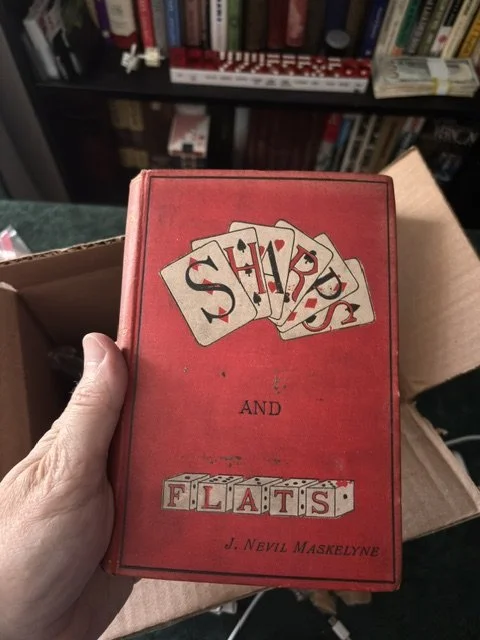
Well, well, well. I knew I had a copy here somewhere…
Well, I read a book called Sharps and Flats that explained how to make the cards for that type of shoe, that lever type shoe. Right away I made up a homemade deck. I used an old chemical called Crystal Clear Krylon and made a half-ass deck to try it and I got it to work. And with that particular type of box, you also have to take a needle and you want to mark the edge of the four kings.
The pin holes that trigger the gaff in the box.
Right. That's a huge edge in faro. You would put a little needle mark. It's hard to explain, but if you read Sharps and Flats, you'll see where the needle mark when the card is seated in the shoe is right at the edge of the opening of that top rim. And because the cards are roughed and smooth, it reads the third card down, not the second. And if you pull out the top card and they're rough and smooth, it'll pull two cards over. And if the rough and smooth aren't together, it'll just slide the one directly under over.
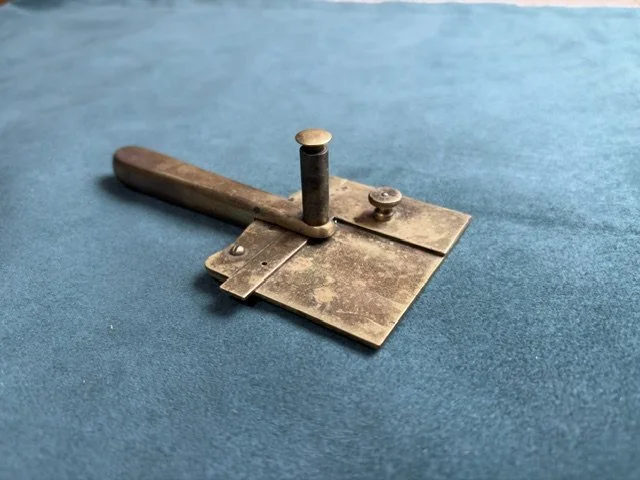
An extremely rare Will & Finck faro punch, used to apply tiny scalped slots to the edge of targeted playing cards.
And when it pulls two cards over, now when you get to that one, the little hole, that pinprick that you put in, well you know now that the next card coming is a smooth card, depending on how you use it. If you read those instructions, it'll make sense but it's too hard for me to explain.
Anyway, I discovered the box was gaffed and I got all excited about it.
I asked the proprietor of the antique shop, a guy named Doug Mowen, who was just an antique dealer, where he got it. And Doug told me he got that box from an old guy named Cadillac Hank, right down the street in Superior.
I went there, and it's an old, old wooden floor cigar store. It was an old pool hall. And Hank was there, wore the old Buster hat, you know? He was an older guy, maybe upper eighties or something like that. An old timer.
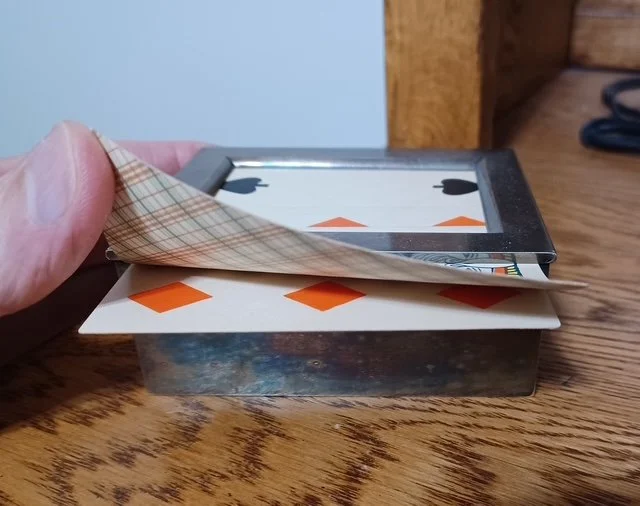
A gaffed faro box.
I said to him, “Yeah, this box I bought, according to Doug Mowen, he got it from you. I was just wondering if you knew anything about it”.
He says, well, you know, that they used to play some faro in the back, they used to run a faro game there and he had a guy he would hire as a dealer.
Sure enough, he had a whole bunch of faro equipment in the back, two faro boxes, a complete layout, the casekeeper, the card press, that's what they call it, that holds all the decks of faro cards in it. The card press was packed full of faro decks. They had the table, you know, the faro bank they call it.
Amazing find.
He had all that stuff.
So, I bought the whole bunch from Hank, and I asked him if he knew anything about that first box I had bought.
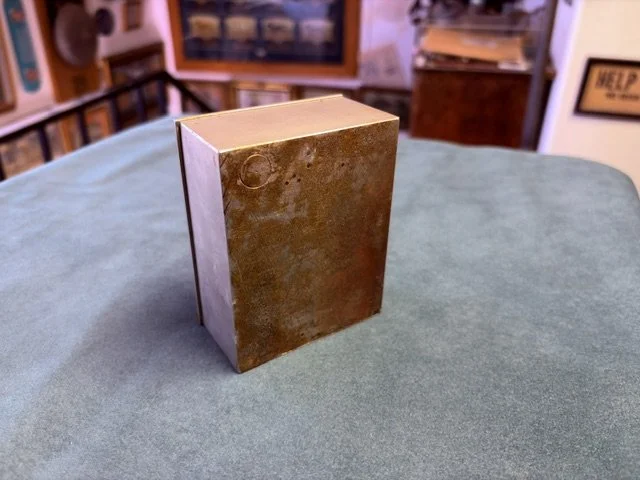
A gaffed faro box showing a hidden switch to activate the dealing mechanism. The small button would be hidden from view by green baize glued to the surface of the box.
He says, “Yeah, I think it belonged to a guy who lives across from here, kitty corner, down at the old hotel.”
He told me the dealer’s name and so just off the cuff I went down there and knocked on the door and the guy answers!
I says, “You know, I bought a bunch of old faro stuff from Hank and I bought a box at the antique shop. I'm interested in the history of faro. Would you mind telling me about the old faro games and this and that? I'd like to write maybe a little bit of an article or something. I'm just interested in it.”
And he invited me in. We had a great talk for about fifteen or twenty minutes. And I thought, you know, now's the time.
I brought out that box that I discovered with the gaff and I happened to show it to him. I says, “I got this box from Doug Mowen”.
He looked it over and it had a number inside it. He said yeah, that's his old box that he used to deal.
I says, “I wonder if you could tell me something.”
And I showed him how it unlocked with that little lever.
Well, at that moment, the old guy got up, picked up his chair, walked over to the corner, turned the chair toward the corner, just the way you'd send a kid to the corner, sat in that chair, crossed his arms, and would not say one word to me.
And after a couple of minutes and him not saying a word and staring at the corner, I got the hint. I just left, never met him after that.
It shows you how true to the code the old faro dealers were.
***
For more stories about crooked gambling methodologies, tools, culture and psychology, check out Andrew Wimhurst’s book, Thieving Bastards: True Confessions of the World’s Greatest Cheats.
It’s a UNIQUE true crime deep dive into the dark underbelly of American gambling. Available now from The Cold Deck Company website in hardcover and as an ebook from Amazon.
All images and text are copyright Andrew Wimhurst and The Cold Deck Company